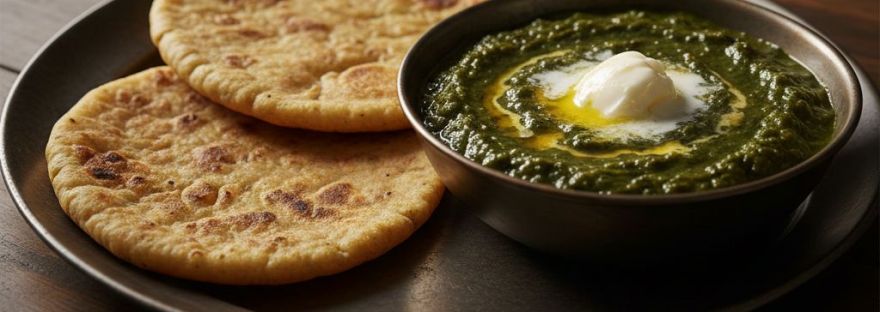
In a Punjabi home, winter doesn’t arrive with the first frost; it arrives with the first bunch of Sarson (mustard greens) on the kitchen counter. I remember my mother spending hours in the morning fog, meticulously cleaning the greens leaf by leaf. She called it the “Season’s Meditation.”
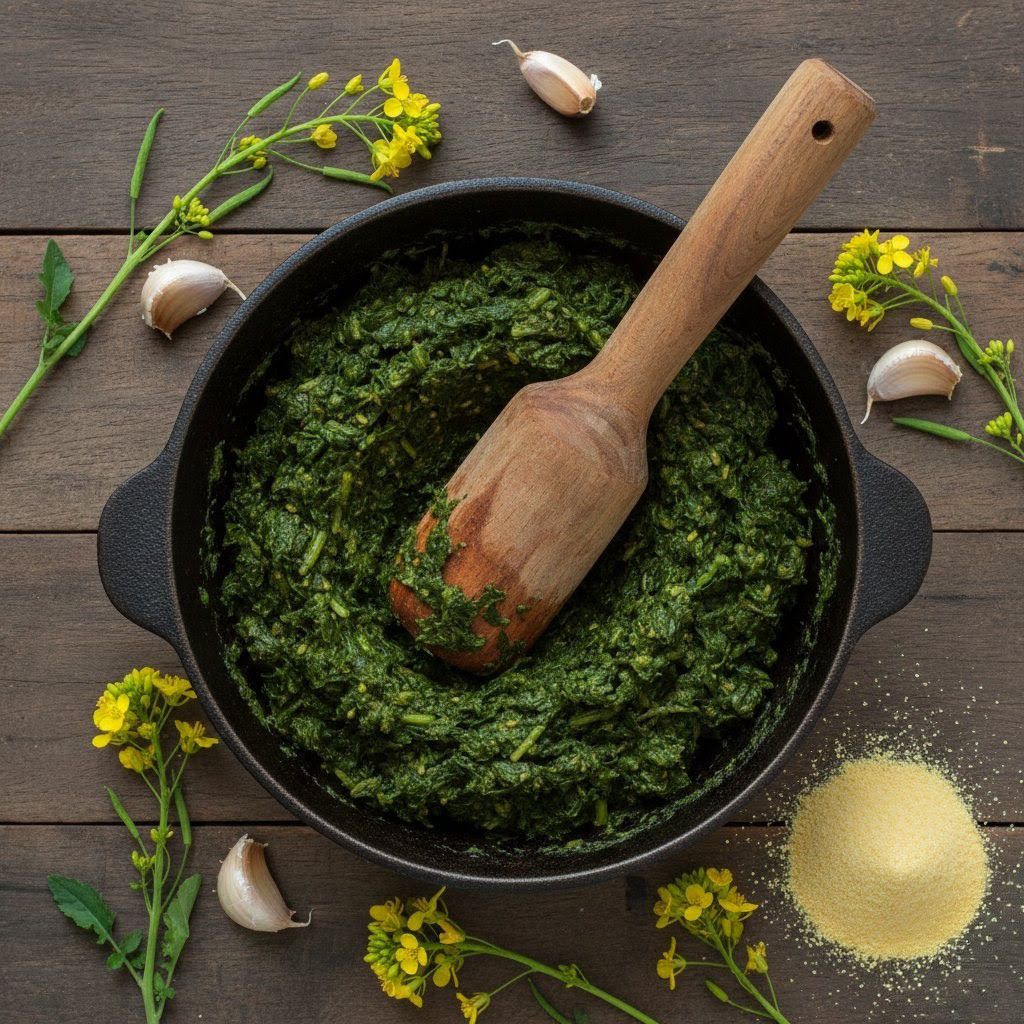
While the world now uses high-speed blenders, she remained loyal to her Ghotna the heavy wooden masher. She believed that a blender “killed the soul” of the greens, whereas the manual mash preserved the coarse, creamy texture that defines a true saag. To her, Makki Ki Roti (cornmeal flatbread) was the essential partner, a “Parasocial Companion” that required the warmth of her palms to hold its shape. Watching her hand-pat the gluten-free dough into perfect circles was a masterclass in “Quiet Luxury” it was slow, it was technical, and it was deeply honest.
Today, at The Pinch of Masala, we are documenting this winter ritual for a 2026 audience that craves “Ingredient Integrity” and the rugged health benefits of “Fibremaxxing”.
The barrier to a perfect saag is often a bitter taste or a watery texture. To master this Punjabi masterpiece, follow my mother’s three non-negotiable rules:
The “Trinity of Greens” Ratio: In 2026, we prioritize balance. My mother used a strict 2:1:1 ratio 2 parts Sarson (mustard) for pungency, 1 part Palak (spinach) for creaminess, and 1 part Bathua (chenopodium) for an earthy depth. This prevents the mustard from becoming overwhelmingly bitter.
The “Allan” Binder: This is the ultimate “Digital Anthropologist” secret. Once the greens are mashed, you must add Makki ka Atta (maize flour) while the saag is simmering. This flour acts as a “binder” (traditionally called Allan), absorbing excess moisture and transforming a loose mash into a velvety, cohesive gravy.
The Hot Water Knead: Makki ka atta is notoriously brittle. To make soft rotis that don’t crack at the edges, you must use boiling hot water to knead the dough. The heat partially gelatinizes the starch, making the dough pliable enough to shape by hand.
Prep time: 30 mins | Cook time: 60 mins | Servings: 4
Diet: Vegetarian, Gluten-Free (Roti) | Cuisine: Punjabi Heritage
Ingredients:
For the Saag:
1 kg Sarson (Mustard Greens): Cleaned, stems included (peel the tough outer skin of thick stems).
250g Palak (Spinach) & 250g Bathua (Chenopodium): Cleaned and sorted.
The Aromatics: 2-inch Ginger (grated), 10 cloves Garlic (crushed), 4-5 Green Chillies (chopped).
The Allan: 3 tbsp Makki ka Atta (Maize Flour).
The Tadka: 3 tbsp Ghee, 2 Dry Red Chillies, 1 Onion (finely chopped), 1 Tomato (optional).
The Finish: A huge dollop of white butter (Makhan).
For the Makki Ki Roti:
2 cups Makki ka Atta: Fine ground yellow cornmeal.
½ cup Radish (Mooli): Grated (for moisture and flavor).
1 tsp Ajwain (Carom seeds): For digestion.
Liquid: Boiling hot water as needed.
Instructions:
The Boil: Add all the greens, ginger, half the garlic, and green chillies to a pressure cooker with 1 cup water and salt. Cook for 2 whistles, then simmer on low for 20 minutes.
The Ghotna Ritual: Once cooked, drain the excess water (save it!). Use a wooden masher (ghotna) or a stick blender (on pulse mode) to mash the greens into a coarse, thick paste. Do not make a smooth puree.
Thicken: Return to the heat. Slowly sprinkle in the 3 tbsp of cornmeal (Allan) while stirring constantly to avoid lumps. Simmer for 10 minutes until the saag looks creamy and glossy.
The Tadka: Heat ghee in a pan. Add dry chillies, remaining garlic, and onions. Sauté until deep golden brown. Add tomatoes and spices. Pour this into the saag and mix well.
The Roti Dough: Mix cornmeal, salt, ajwain, and grated radish. Gradually add boiling water and mix with a spoon. When cool enough to touch, knead vigorously with the heel of your hand for 8 minutes until smooth.
Shape & Roast: Take a ball of dough. Hand-pat it between your palms or roll between two parchment sheets. Roast on a medium-hot tawa with ghee until both sides have golden-brown blisters.
Serve: Serve the saag piping hot, topped with white butter and a piece of jaggery (gud) on the side, with the crispy rotis.
The Saag Water: In the 2026 “Use-Up” economy, we value every nutrient. Never throw away the water drained from the boiled greens! It is packed with iron and minerals. Use this “Green Gold” to knead your Makki ki Roti dough instead of plain water—it adds a subtle earthy flavor and ensures no vitamins are wasted.
 The Pinch of Masala