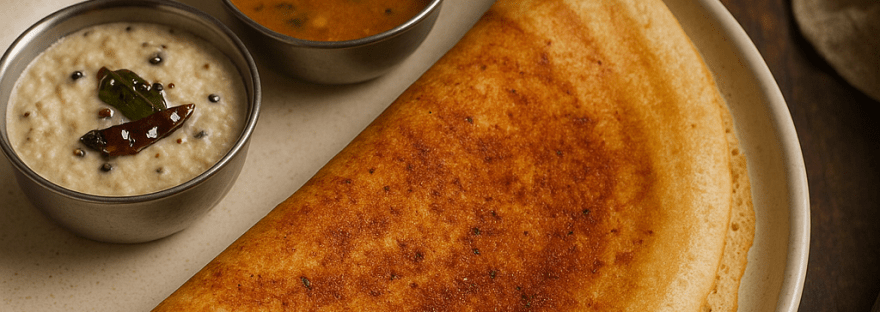
I still remember those mornings when the house filled with the gentle sizzle of a dosa on the griddle and the rich scent of ghee in the air. In my family’s kitchen, breakfast was a warm ritual. My grandmother would ladle fermented dosa batter onto a hot cast-iron tawa, spreading it thin and circular. As it cooked, she’d sprinkle spicy milagai podi (literally “chili powder”) over the pancake. The moment was magic – a golden triangle of crispy dosa, flecked with nutty-red podi and glistening with melted ghee, was placed before me. I’d bite into its crisp edge, letting the fiery gunpowder blend with the savory dough, chased by sips of strong filter coffee. These simple flavors – the coconut-chutney dip, the tangy sambar – evoke the comfort of home and childhood.
In Tamil homes idli podi or milagai podi is a beloved staple. It’s a coarse, earthy mix of roasted lentils (like chana dal and urad dal), dried red chilies, sesame seeds and spices. South Indians call this mixture “gun powder” for the fiery kick it gives, and they sprinkle it not only on idlis but on dosas too. As one recipe notes, *“Idli Podi is also known as Milagai Podi… ‘Milagai’ means chilies and ‘Podi’ is powder.”* In fact, podi is often described as a coarse breakfast condiment used alongside idli and dosa, made from roasted dals and spices. A pinch of this powder on a hot dosa, drizzled with fragrant ghee, turns each bite into a burst of homestyle flavor.
Crucial to the perfect podi dosa is the batter. Dosas start with a naturally fermented batter of rice and urad dal. After soaking and grinding, the mixture is left to ferment overnight until it doubles and becomes bubbly. Swasthi’s Recipes explains: “After a good fermentation, the batter increases in volume, becomes light with plenty of small air pockets and develops a slight tangy flavor”. When you ladle this fermented batter onto a hot griddle and cook it with a little ghee or oil, it crisps up into a thin, golden crepe. (For extra crispiness, Serious Eats even suggests substituting some of the rice with parboiled rice.) The result is a lacy-edged dosa that’s perfect for holding a layer of spicy podi and glossy ghee.

Ingredients
For the Dosa batter: 2 cups raw rice (short-grain rice or sona masuri), ½ cup whole urad dal (skinned black gram), water for soaking/grinding, and salt to taste. (You may also add a tablespoon of poha or fenugreek seeds to the soak for a fluffier texture.)
For the Podi (gunpowder) mix: 2 tbsp white sesame (til) seeds, 1 tsp cooking oil, ¼ cup urad dal, ¼ cup chana dal, 6–8 dried red chilies (adjust for heat), a few fresh curry leaves, 2 tbsp dry coconut (copra), a small piece tamarind, ¼ tsp turmeric powder, a pinch of asafoetida (hing), and 1 tsp salt.
For cooking: Additional ghee (clarified butter) or oil for the griddle.
To serve: Coconut chutney, sambar, and strong South Indian filter coffee (optional) as accompaniments.
Method
1. Prepare and ferment the batter: Rinse the rice and urad dal separately and soak both in plenty of water for at least 4–6 hours (or overnight). Drain and grind them separately with just enough water to make a smooth paste. Combine the rice and dal batter, add salt, and stir well. Cover and ferment in a warm spot for 8–12 hours (or until doubled and bubbly). As noted by Swasthi, after fermenting *“the batter increases in volume, becomes light with plenty of small air pockets”*. This fermented batter will yield thin, crisp dosas when cooked.
2. Make the podi (spice mix): Dry-roast the ingredients slowly to bring out their aroma. In a large skillet on low heat, toast 2 tbsp sesame seeds until fragrant; transfer them to a plate. Add 1 tsp oil to the pan, then throw in ¼ cup urad dal, ¼ cup chana dal, 6 dried red chilies and a few curry leaves. Roast this mixture on low heat, stirring constantly, until the dals turn golden and the chilies darken (watch carefully so nothing burns). Now add the 2 tbsp dry coconut and continue to roast until the coconut is lightly browned. Let everything cool. Then transfer the roasted mix to a blender or spice grinder. Add the toasted sesame seeds, a small tamarind ball, ¼ tsp turmeric, a pinch of asafoetida, and 1 tsp salt. Grind to a coarse powder without adding water. You now have the spicy podi. (Tip: This coarse chili-lentil powder can be stored in an airtight jar for weeks.)
3. Cook the dosa: Heat a well-seasoned griddle or nonstick pan over medium-high heat. When the pan is hot, reduce heat to medium and pour a ladleful of the fermented batter onto the center. Quickly tilt and rotate the pan in a spiral motion to spread the batter thinly (you can also spread with the back of the ladle). Cover and cook for about 1 minute. The underside should be light golden and you will see small holes form on top as it cooks.
4. Add podi and ghee: Remove the lid. Evenly sprinkle 1–2 teaspoons of the prepared podi all over the semi-cooked dosa (as shown by Hebbar’s Kitchen). Immediately drizzle or spread about 1 tsp ghee (or oil) on top. Spread it lightly with the back of the ladle so it coats the surface. Continue cooking uncovered for another 30 seconds or so until the dosa edges curl up and the entire crepe turns golden brown and crisp. Swasthi’s guide reminds us that dosas are cooked *“with a little oil, ghee or butter until crisp”*. Indeed, adding ghee not only crisps the dosa but adds a rich aroma – as one recipe notes, *“podi dosa tastes great when dosa is prepared with ghee.”*
5. Serve hot: Fold or roll the dosa onto a plate. Serve it immediately while sizzling. Traditionally, podi dosa is enjoyed with steaming coconut chutney and hot sambar. Pour a tumbler of South Indian filter coffee to sip alongside. Each bite of the crisp, golden dosa with its fiery podi and buttery ghee, paired with cool chutney and hot sambar, delivers a warm, comforting taste of home.
 The Pinch of Masala