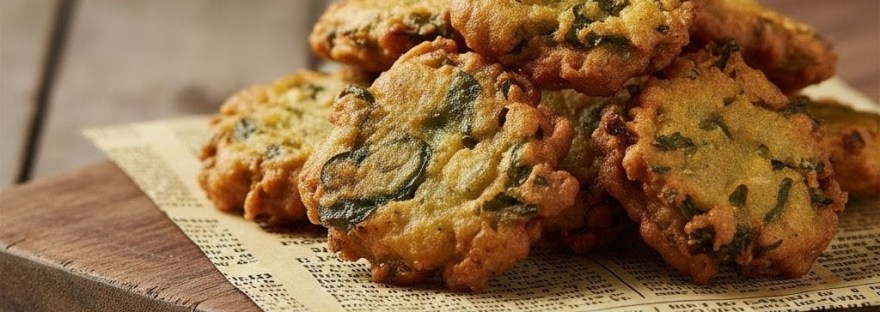
In our family, the first scent of a monsoon rain didn’t come from the earth; it came from the kitchen. I remember my mother reaching for a large bunch of fresh palak the moment the clouds turned charcoal. To her, Palak Pakora wasn’t just a snack; it was a sensory response to the weather.
She believed that spinach had a “memory” of the rain, and frying it was the only way to lock that freshness in. I can still see her standing by the stove, her bangles clinking as she hand-tossed the leaves in a golden mantle of chickpea flour. “Never use a spoon to mix,” she would tell me. “Your fingers need to feel if the leaves are happy.” She taught me that the secret to a perfect pakora lay in the “Quiet Luxury” of a batter that whispered rather than screamed thin enough to see the green, but thick enough to crunch.
Today, at The Pinch of Masala, we are honoring her ritual by avoiding the heavy, doughy fritters of street stalls. We are returning to the “Whole Leaf” heritage style that celebrates the “Ingredient Integrity” of the spinach itself.
The most common grievance with Palak Pakora is that they turn soft and soggy within minutes. To achieve my mother’s “Eternal Crunch,” you must master the Moisture War:
The “No-Water” Rule: This is the ultimate “Digital Anthropologist” secret. Do not add water to your batter. My mother would salt the shredded spinach and let it sit for 5 minutes. The salt creates a hypertonic environment, drawing out the natural juices of the leaves. You then add the besan (gram flour) directly to these juices. This ensures the batter is made of 100% spinach essence, making it impossible for the pakoras to turn soggy.
The Rice Flour Catalyst: In 2026, we value “Technical Excellence”. Adding exactly two tablespoons of rice flour acts as a moisture-wicking agent, creating a glass-like crunch on the exterior that protects the tender “Fibremaxxing” leaves inside.
Prep time: 10 mins | Cook time: 15 mins | Servings: 4
Diet: Vegan, Gluten-Free | Cuisine: North Indian Street Food

Ingredients:
250g Fresh Palak (Spinach): Roughly chopped into wide ribbons.
1 cup Besan (Gram Flour): Sifted for a smooth texture.
2 tbsp Rice Flour: For the signature “Heritage Crunch.”
The Aromatics: 1 Large Onion (thinly sliced), 1 inch Ginger (grated), 2 Green Chillies (chopped).
Spices: 1 tsp Cumin seeds (Jeera), ½ tsp Turmeric, 1 tsp Carom seeds (Ajwain essential for digestion), and Salt to taste.
Fat: Oil for deep frying (Cold-pressed Peanut or Mustard oil is preferred for authenticity).
Instructions:
The Salt Ritual: Place the spinach and sliced onions in a large bowl. Sprinkle with salt and ajwain. Massage the leaves gently with your fingers and let them rest for 5–8 minutes until they look “sweaty.”
The Dry Mix: Add the ginger, chillies, and dry spices.
The Coating: Sift in the besan and rice flour. Mix with your hands. The moisture from the spinach will begin to form a thick, sticky paste that coats the leaves. Do not add water.
The Temperature Test: Heat oil in a heavy-bottomed kadhai. Drop a tiny bit of batter; if it rises immediately with a sizzle, the oil is ready.
The Drop: Take a small, irregular clump of the mixture and drop it into the oil. Do not shape them into perfect balls; the craggy edges are where the crunch lives!
The Gold Standard: Fry on medium heat for 3–4 minutes, turning once, until they are a deep, sun-kissed golden brown.
Serve: Drain on a paper towel and serve immediately with tangy Tamarind Chutney or a steaming glass of Masala Chai.
The “Pakora Choora” (Leftover Crumbs): In the 2026 “Use-Up” economy, nothing is wasted. My mother never threw away the tiny crispy bits of batter left at the bottom of the pan (the choora). Save these in an airtight jar. They make the perfect “zero-waste” topping for your morning Poha or a bowl of Dal, adding a concentrated hit of spice and texture.

 The Pinch of Masala