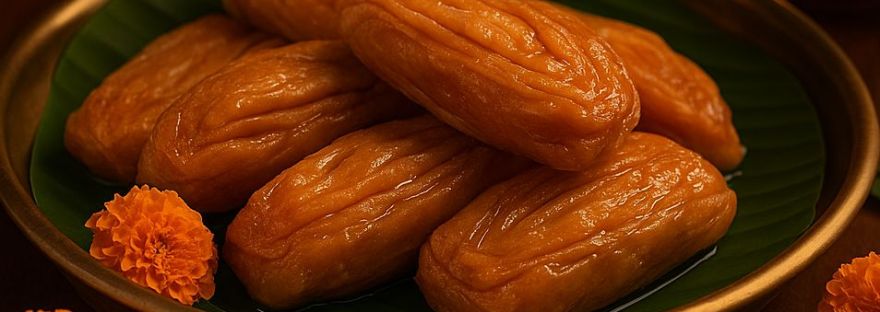
Every summer, the holy city of Puri in Odisha comes alive with the roar of chariots and the scent of sweets during Ratha Yatra. One aroma that signals festival time is that of Khaja (Khoja) – a crispy, layered pastry soaked in sugar syrup. This iconic Odia sweet is multi-layered, crisp and flaky by design, and it is more than just a dessert – it’s a symbol of devotion and tradition. In fact, Khaja is one of the 56 offerings (Chhappan Bhog) served daily to Lord Jagannath as Mahaprasad. Pilgrims often buy baskets of Khaja from the Jagannath Temple bazaar (Ananda Bazar) to carry home and share with neighbors and family. For many Odias, no visit to Jagannath is complete without that first reverent bite of Khaja.
During Ratha Yatra, temple kitchens prepare special sweets like Poda Pitha and Rasabali – and Khaja is offered as a festive treat to the deities. It symbolizes the sweetness of divine blessings as the snack is ceremonially served on the chariot or as temple prasadam. Devotees fondly recall childhood scenes: watching the grand chariot procession, then coming home to the warm, honeyed smell of freshly-fried Khaja. Many Odia families make or purchase Khaja during the festival to distribute as prasad at home. In fact, tradition holds that even a Khaja bought from a shop is treated with reverence – many Odias instinctively touch their head with gratitude at the first bite. This affectionate respect underlines how deeply Khaja is woven into the Ratha Yatra experience.
The Temple Tradition and Cultural Significance
Khaja’s roots are ancient and pan-Indian, but it has become uniquely Odia through Jagannath worship. By the time Khaja was included in the 12th-century Jagannath Temple offerings, Odia cooks had adapted the recipe to local tastes and resources. They added refined wheat flour (maida) to the dough along with ghee. The addition of maida gave the pastry extra elasticity and crisp layers that trap sugar syrup in every fold. This technique yields the flaky texture that Puri’s Khaja is famous for.
Anand Bazaar on the temple grounds is famous for its khaja stalls: devotees queue up to receive a piece as Mahaprasad (sacred food). The crispy sweet, also known as Feni, is emblematic of Jagannath culture. Indeed, Odisha’s daily offering of 56 dishes to Lord Jagannath always includes Khaja, making it a symbol of faith and cultural pride. After darshan, families often bring home wicker baskets of Khaja to share – a tradition that bonds communities. In villages and cities alike, the sight of Tulsi leaves or banana leaves beneath fresh Khaja is a familiar one on festive mornings, and every bite is considered a little blessing from the Lord.

Ingredients (for Flaky Khaja)
All-purpose flour (maida) – 2 cups
Ghee (clarified butter) – 3–4 tablespoons melted (plus extra for brushing)
Salt – a pinch
Warm water – as needed to knead the dough
Oil or ghee – for deep frying
Sugar syrup: 1 cup sugar dissolved in ½ cup water (boiled to a light thread consistency)
Cardamom powder – ¼ teaspoon (optional, for fragrance)
Chopped nuts or saffron – a few strands for garnish (optional)
(Notes: The refined flour and ghee help create the signature layers. Traditionally, maida alone was used in the temple version for a creamier color and texture.)
Method
1. Make the dough: In a mixing bowl, combine the flour and salt. Add the melted ghee and use your fingers to mix until the flour resembles coarse crumbs. Optionally add a pinch of cardamom powder for aroma. Gradually pour warm water and knead into a firm, smooth dough. Cover and let it rest for about 30 minutes.
2. Prepare sugar syrup: While the dough rests, make the syrup. In a pan, dissolve the sugar in ½ cup water and bring to a boil. You may add a teaspoon of lemon juice to prevent crystallization. Simmer until the syrup reaches a light one-thread consistency. Keep the syrup warm.
3. Roll out layers: Divide the dough into 4–5 equal balls. Roll each ball into a very thin circle (like a chapati). Brush the surface of one circle lightly with ghee, and dust a little extra flour (or cornflour) to prevent sticking. Place a second rolled circle on top and brush with ghee again. Stack all rolled circles (brushing each) into a layered stack.
4. Form the rolls: Roll the stacked layers tightly into a cylinder log. Seal the edge by pressing a little water if needed. Trim the ends and cut the log width-wise into 8–10 short rolls (each about 1–1.5 inches long).
5. Flatten the pieces: Take each little roll and press gently down its center with your finger or a rolling pin, so it flattens slightly but keeps its layered shape.
6. Deep-fry: Heat oil in a deep wok over medium heat. Fry the prepared pieces on medium-low heat first, then increase to medium. Fry slowly until they turn a rich golden-brown on all sides, turning carefully so both sides crisp evenly. (Low-to-medium heat ensures the layers puff up and cook through.) Remove the fried Khaja and drain on paper towels.
7. Soak in syrup: While the Khaja is still hot, dip each piece into the warm sugar syrup for 1–2 minutes, coating it fully. Lift them out and arrange on a rack or plate. As they cool, the syrup will crystallize slightly on the surface, giving that final delicate crunch.
8. Serve: Once cool, transfer the flaky Khaja to a serving platter. Optionally, sprinkle with chopped nuts or saffron strands for color. Serve with warm tea, or pack them as prasad – the Khaja stays fresh and crisp for days thanks to its syrup coating.
Enjoy the crisp layers and sweet fragrance of homemade Khaja, a festival favorite from Odisha. Each bite of this temple treat carries a touch of history and devotion – a true Chhappan Bhog delight.

 The Pinch of Masala